The Short Version
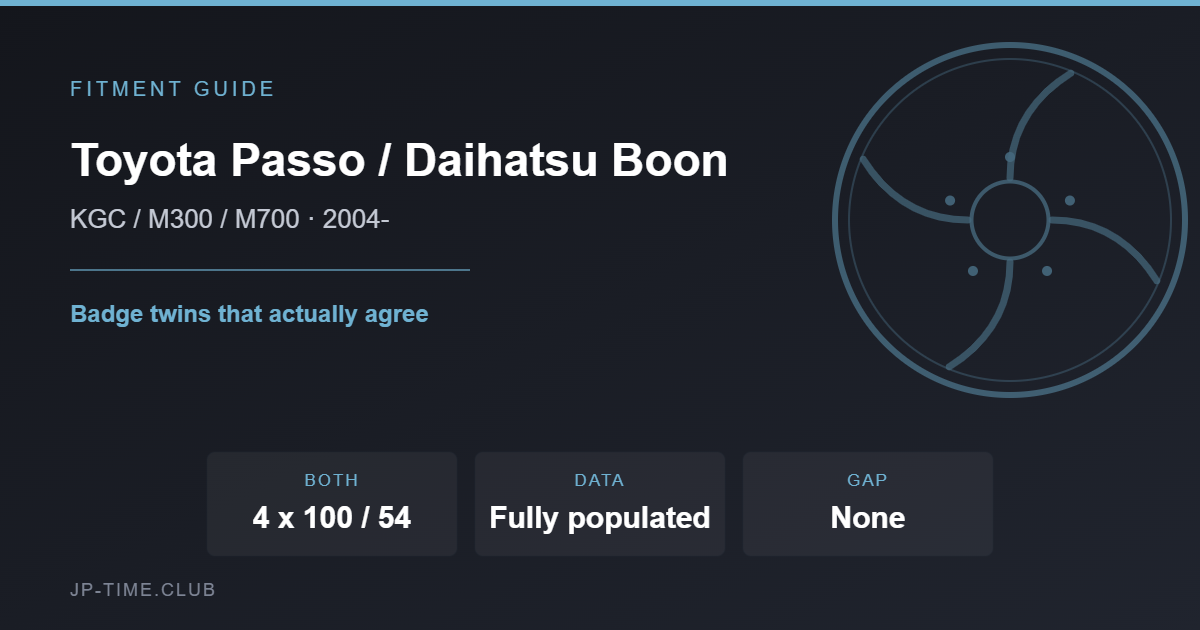
- 4×100 on a 54 mm bore, both badges, every generation.
- Both pages are fully populated. No gap between the twins.
- The bore is published on every row, back to 2004.
- Wheels move from 4.5J×13 +35 to 5J×14 +35 across the generations.
Badge Twins That Actually Agree
We track this carefully because it keeps going wrong. Five times now we have found badge-engineered pairs where one page carries a hub bore and its twin does not:
- Carina ED has 60 mm; Corona EXiV has nothing, on identical chassis codes
- Wingroad has 60 mm; AD Wagon has nothing, same codes
- Corolla II is missing two whole generations that Corsa and Tercel carry
- Gaia has 60 mm where Ipsum has nothing, for the same chassis code and production window
- Domani and Orthia have 56 mm; Integra SJ has nothing
The Passo and Boon do not join that list. Every chassis code on both pages returns 4×100 with a 54 mm bore, and both pages are complete.
| Badge | Chassis | Period | Wheel | PCD / Holes / Bore |
|---|---|---|---|---|
| Passo | KGC10, KGC15 | 2004–2010 | 4.5J×13 +35 | 100 / 4 / 54 |
| Passo | KGC30 era | 2010–2016 | up to 5J×14 +40 | 100 / 4 / 54 |
| Passo | M700A, M710A | 2016– | 5J×14 +35 | 100 / 4 / 54 |
| Boon | M300S, M301S, M310S | 2004–2010 | — | 100 / 4 / 54 |
| Boon | M600S, M601S, M610S | 2010–2016 | — | 100 / 4 / 54 |
| Boon | M700S, M710S | 2016– | — | 100 / 4 / 54 |
Note the current generation shares chassis codes almost exactly — M700A/M710A for the Passo, M700S/M710S for the Boon. One letter apart, same car.
Which Way Round the Badge Engineering Goes
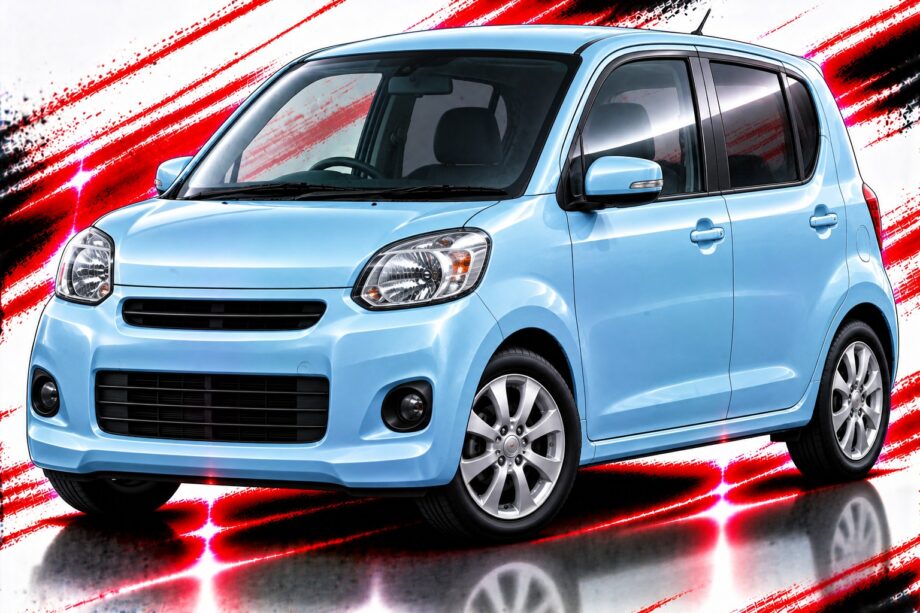
Worth stating because people get it backwards. The Daihatsu Boon is the original and the Toyota Passo is the rebadge — Daihatsu designs and builds it, Toyota sells it through its own network.
That is the opposite of the usual assumption that the Toyota is the parent product. It also explains the fitment: 4×100 on 54 mm is simultaneously Daihatsu’s kei-and-small-car figure and Toyota’s small-car figure, so the two conventions happen to agree and nothing had to be reconciled.
Compare with the Subaru Pleo and Stella, where a Daihatsu takeover moved the bore from 59 to 54 because Subaru’s own convention was different.
Buying
4×100 on 54 mm is the most abundant fitment in Japan. Wheels from the Tanto, the Mira and Move, the Vitz and the Corolla all fit directly.
The check, as always on 4×100: Honda and Mitsubishi use 56 mm. A wheel from a Honda kei car or a Civic will bolt to a Passo and sit two millimetres loose.
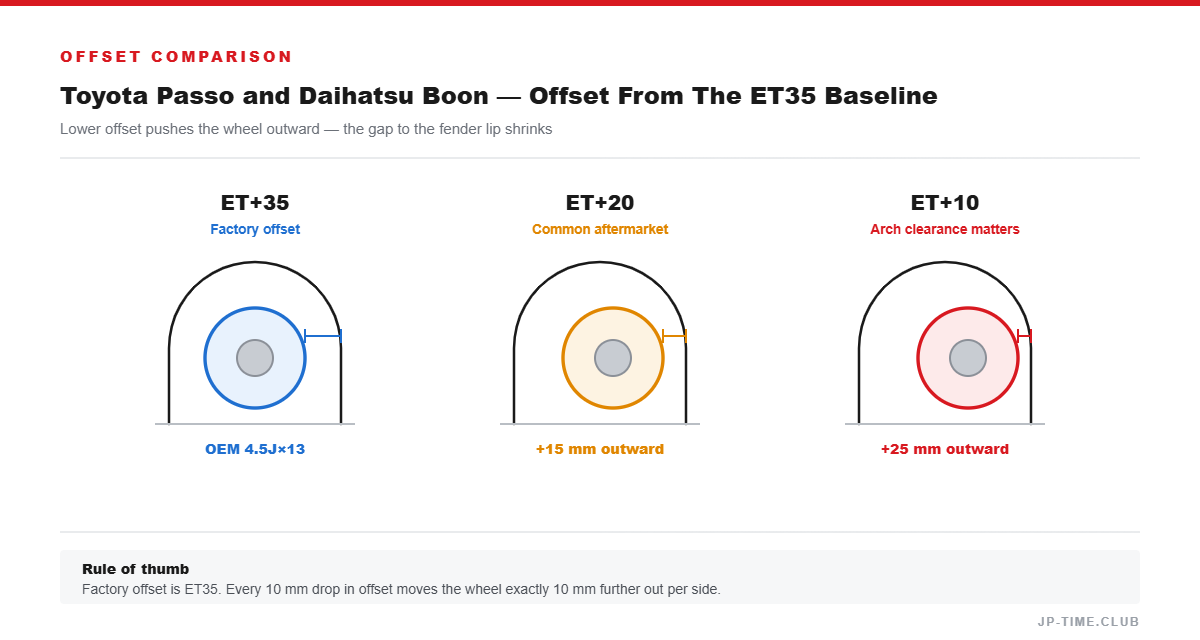
Offsets sit at +35 to +40, which is low for a small Toyota — the Raum is +39 to +45 and the Corolla +39 to +45. So Passo wheels sit slightly further out than most small Toyotas, and going to a higher-offset wheel will tuck them in.
Importing
The Passo and Boon launched in 2004, so first-generation cars become eligible for US import from 2029.
Neither was sold in North America. The Boon and Passo are the cars that replaced the Starlet and the Duet in this class, and the Boon X4 — a turbocharged four-wheel-drive rally homologation version of the first generation — is the one worth knowing about, though we did not isolate its rows here.
What We Could Not Verify
- Passo Sette and Boon Luminas, the seven-seat minivan variants. Both exist on the manufacturer index; we did not open them.
- Whether the Boon X4 appears with distinct figures.
- Tyre sizes, which the aggregate pages mostly leave blank.