
The Short Version
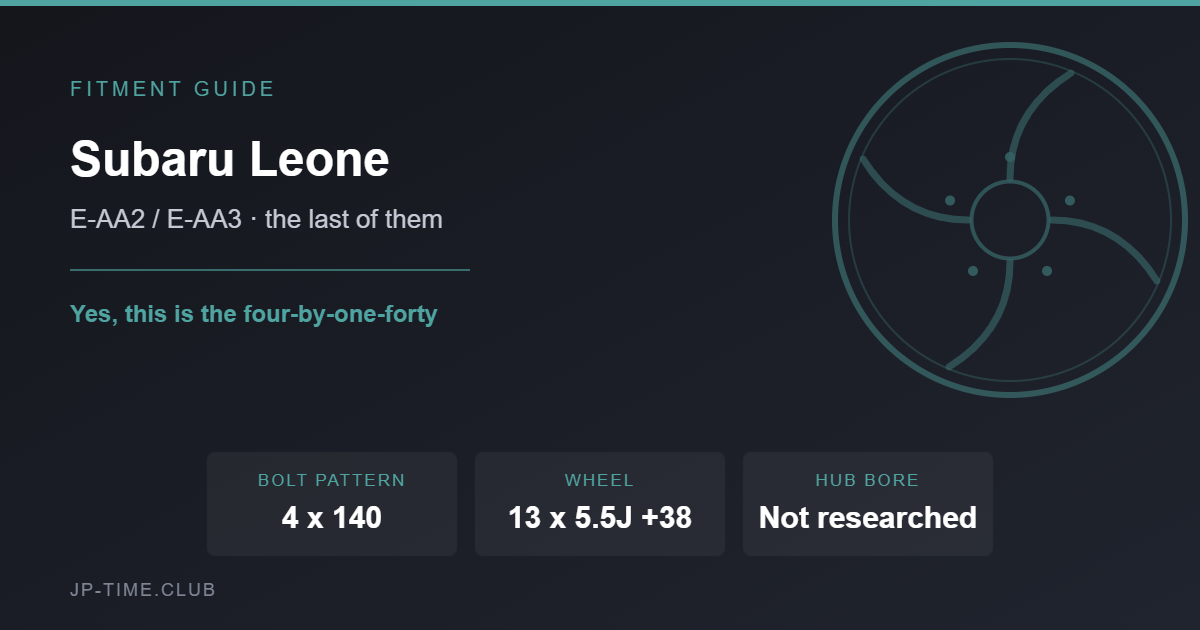
- 4×140. Confirmed, on 13×5.5J at +38.
- Coverage is one seventeen-month window. November 1989 to March 1991, base grades only.
- The hub bore has never been researched.
- No RX or RX-II turbo grade is in the database at all.
The Pattern People Ask About
We recently published a guide to the Domingo, Justy and Dias Wagon and noted that all three are 4×100, not the 4×140 people expect from an old Subaru.
The obvious follow-up question is: which Subarus were 4×140?
Here is one, confirmed:
| Chassis | Period | Grade | Wheel | Tyre | PCD / Holes / Bore |
|---|---|---|---|---|---|
| E-AA2 (2WD) | 1989.11–1991.03 | Maia, Maia II, 5MT and 4AT | 13×5.5J +38 | 155SR13 | 140 / 4 / Not researched |
| E-AA3 (4WD) | 1989.11–1991.03 | Maia, Maia II, 5MT and 4AT | 13×5.5J +38 | 155SR13 | 140 / 4 / Not researched |
140 mm on four studs is a genuinely unusual bolt circle. It is wide — wider than the 114.3 used on large rear-drive Japanese saloons — on a car with 13-inch wheels. That combination is why 4×140 wheels are hard to find and why Leone owners have a real problem the Domingo owners do not.
What the Database Actually Covers
We need to be precise about how thin this is, because it is the most limited entry we have published.
The Leone page contains seven rows. All of them are chassis E-AA2 or E-AA3, all dated November 1989 to March 1991, all base Maia and Maia II economy grades.
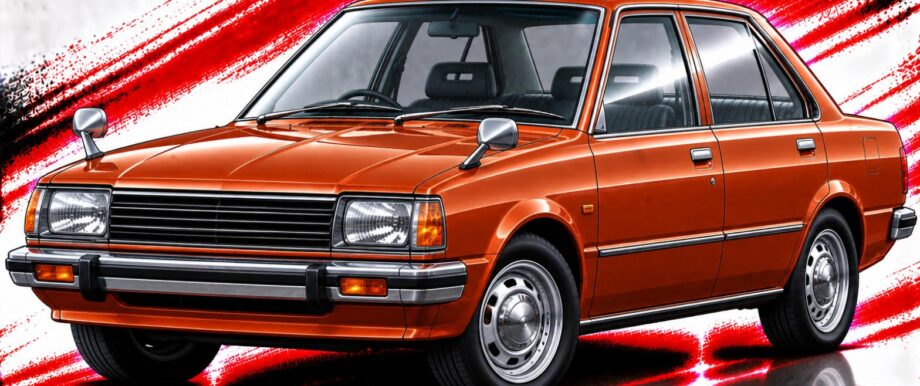
That is the tail end of the Leone’s life in Japan — the budget model Subaru kept selling after the Legacy launched, essentially the same generation exported as the Loyale. The Leone ran from 1971. Everything before November 1989 is absent.
So this article confirms 4×140 on the last Leones and tells you nothing reliable about the twenty years before them. That is a real limit, not a hedge.
The RX and RX-II Are Not There
The grades enthusiasts want — the turbocharged and four-wheel-drive RX and RX-II — do not appear on the page at all. Only Maia and Maia II.
They are on the same platform, so 4×140 is a reasonable expectation. We are not going to state it. A performance grade getting different hardware from a base grade is precisely the thing we have documented eight separate times now, on the Sunny B14, the Mirage Cyborg ZR, the RVR and others. If you have an RX, count the studs and measure the circle.
Measuring a Four-Stud Bolt Circle
Easy, and worth knowing on this car specifically because 140 is far enough from 100 and 114.3 that you cannot mistake it once measured.
On a four-stud pattern, measure centre-to-centre between two studs directly opposite each other. That distance is the PCD — no geometry needed. If it reads about 140 mm you have a Leone-pattern hub; if it reads 100 or 114.3 you have something else and should tell us, because the database only covers seventeen months.
Buying Wheels
4×140 is a difficult pattern and there is no way around that. Your realistic options are period Subaru steel and alloy wheels, and a small number of classic Japanese aftermarket wheels drilled to it.
Because the bore is unresearched, buy something with a generous bore and use a hub ring rather than hunting a wheel machined to an assumed figure. Measure the hub first — on a car this poorly documented it is the only number you can actually rely on.
Importing
The Leone ran to 1994 and every generation is past 25 years, so the whole thing is eligible for US import.
North America received the Leone as the Loyale, so some parts knowledge exists there. The Japanese-market RX grades were not exported, and they are the ones with real interest — a turbocharged, four-wheel-drive Subaru saloon a decade before anyone outside Japan cared.
What We Could Not Verify
- Hub bore, on any grade. Confirmed unresearched on an individual grade page.
- RX and RX-II fitment. Not in the database.
- Any Leone before November 1989, which is twenty of its twenty-three years.