The Short Version
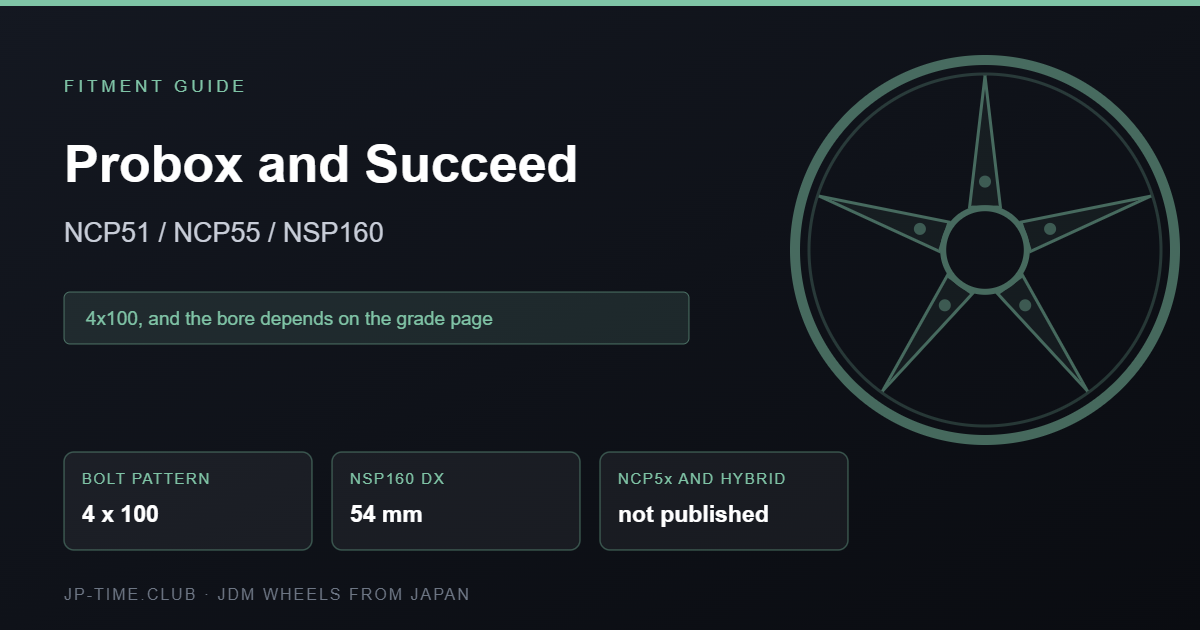
- 4×100 on every Probox and Succeed grade — both generations, 2WD, 4WD, petrol and hybrid.
- The hub bore depends on which grade page you open. The current NSP160 DX reads 54 mm. The older NCP51 and NCP55, and the hybrid grades, read “under investigation”.
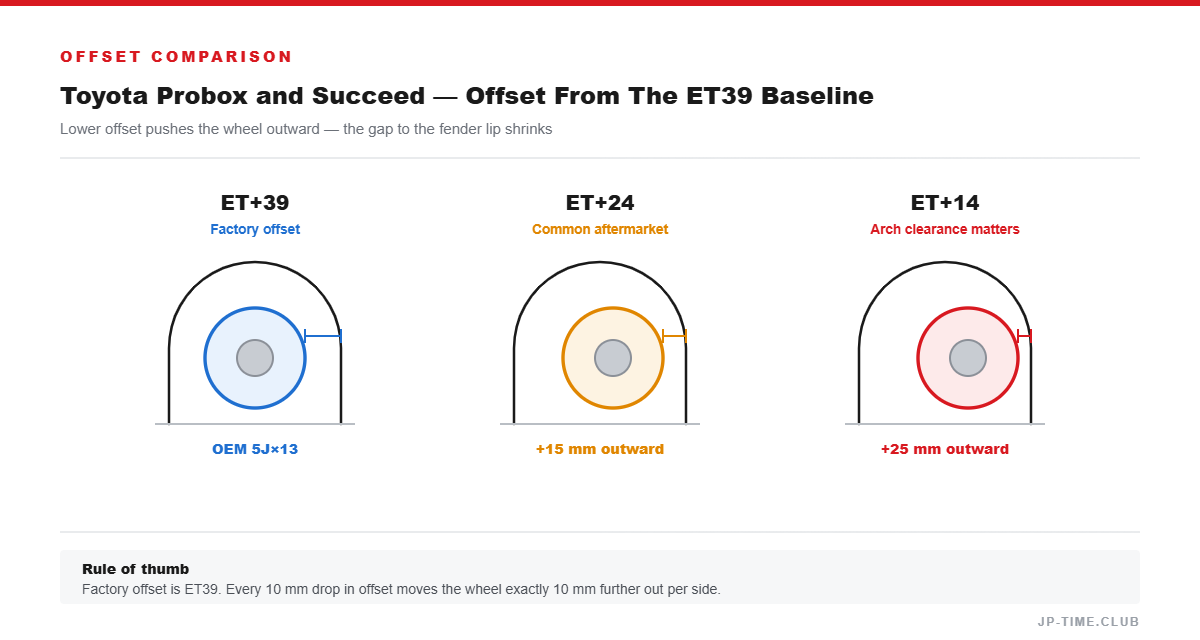
- Factory fitment is tiny: 13×5J at +39 on LT-rated 165R13 for the first generation.
- These are commercial vehicles, and the wheel standard question matters more here than on a passenger car.
The Wheels Are Small and the Tyres Are Rated
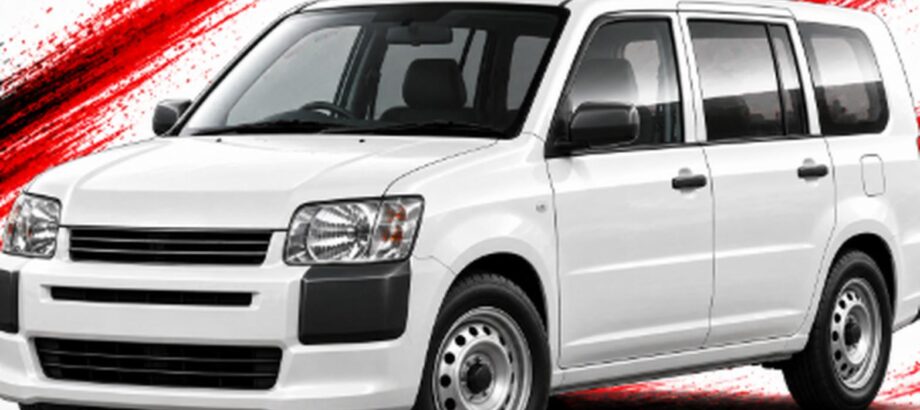
The Probox and Succeed are commercial wagons and the factory fitment reflects it. The first generation runs 13×5J at +39 on 165R13 LT 6PR — a light-truck tyre on a thirteen-inch wheel. The current generation moves to 14×5J at +39 on 155/80R14.
That LT designation is the point. These vehicles are certified to carry load, and the tyre on the certification plate is a load-rated one. Fitting a passenger-car tyre in a similar size is not a like-for-like swap.
Factory Specification
| Generation | Chassis | Period | Grade | Wheel | Tyre | PCD / Holes / Bore |
|---|---|---|---|---|---|---|
| 1st | CBE-NCP51V | 2002–2014 | Van 2WD 1.5 DX 4AT | 13×5J +39 | 165R13 LT 6PR | 100 / 4 / under investigation |
| 1st | CBE-NCP51V | 2002–2014 | Van 2WD 1.5 GL 4AT | 13×5J +39 | 165R13 LT 6PR | 100 / 4 / under investigation |
| 1st | CBE-NCP55V | 2002–2014 | Van 4WD 1.5 DX 4AT | 13×5J +39 | 165R13 LT 6PR | 100 / 4 / under investigation |
| 2nd | DBE-NSP160V | 2014– | Van 2WD 1.3 DX CVT | 14×5J +39 | 155/80R14 | 100 / 4 / 54 |
| 2nd | DBE-NCP165V | 2016–2018 | Van 4WD 1.5 DX CVT | 14×5J +39 | 155/80R14 | 100 / 4 / 54 |
| 2nd, hybrid | 6AE-NHP160V | 2014– | Van 2WD 1.5 Hybrid F and DX CVT | 14×5J +39 | 155/80R14 | 100 / 4 / under investigation |
The Bore Depends on the Grade Page, Not the Chassis Code
This is an unusual pattern and worth flagging. On the current generation, the petrol DX grades read a clean 54 mm — both the 2WD NSP160V and the 4WD NCP165V. The hybrid NHP160V grades on the same body read “under investigation”.
There is no mechanical reason a hybrid Probox would have a different hub from a petrol one. It is far more likely that the database was compiled grade by grade and the hybrid rows were never filled in.
But it means you cannot look up “Probox” and get an answer — you have to look up your grade. And on the entire first generation, 2002 to 2014, no grade has a figure at all.
JWL or JWL-T?
This is the question that actually affects what you can legally fit, and we want to be careful with it.
JWL is Japan’s passenger-car wheel standard. JWL-T is the truck and bus standard, and it is a materially harder test — we covered the difference in our load rating guide and in the Hiace guide, where commercial registration puts the vehicle on the truck side.
For the Probox and Succeed we found secondary Japanese sources stating that a 2014 revision allows commercial vehicles below 3.5 tonnes gross with a payload under 500 kg — which these are — to use JWL-marked wheels rather than requiring JWL-T, provided the tyre load index still matches what the certification plate calls for.
We could not confirm that against the regulation itself. Our sources are tuner-shop and tyre-retailer articles, not the ordinance. So we are reporting it as what the trade says rather than as settled law.
The practical advice does not change either way: match the load index on the plate. A light aftermarket wheel and a passenger-car tyre on a loaded Probox is the wrong specification whichever mark it carries.
Sizing
Most exported Proboxes keep the factory wheel, because they are bought to work. Where they are changed, 14×5.5J or 15×6J at +38 to +45 is the practical window, with the load index as the deciding factor rather than width.
Since the first generation’s bore is unpublished, measure before ordering rings. On the current petrol grades, 54 mm is the figure.
Importing
The first generation launched in 2002, so nothing is eligible for US import yet — the earliest cars qualify from 2027.
That is largely academic. The Probox and Succeed export in enormous numbers to East Africa, the Caribbean and the Pacific, where no such rule applies and where they are among the most common vehicles on the road.
What We Could Not Verify
- Hub bore for any NCP50, NCP51 or NCP55 grade, 2002 to 2014. Marked unresearched on both databases.
- Hub bore for the hybrid NHP160V grades.
- A Succeed-badged page for the current generation. We confirmed the Probox-badged NCP165V; the Succeed shares the chassis code family but we did not open a Succeed-titled page.
- The JWL versus JWL-T regulatory position, which we have from trade sources rather than the ordinance text.