
Why This Page Exists
Four studs means a hundred millimetres. That is what almost everyone believes, sellers included, and it is the single most repeated mistake in the Japanese used-wheel trade.
It is wrong often enough to be worth a page. Here is every car we have personally verified running four studs on a 114.3 mm bolt circle, read off Japanese factory data rather than inferred.
The List
| Car | Which grades | Bore |
|---|---|---|
| Nissan Primera P10 and P11 | All of them, 1990–2001, including the 2.0 Te-V | 66 mm |
| Nissan Serena C23 | All of them, 276 rows | Not researched |
| Nissan Sunny B14 | Upper grades only — Super Touring, diesel Super Saloon, 4WD ATTESA | 66 mm |
| Nissan Sunny B15 | All of them, including the VZ-R | 66 mm |
| Nissan Wingroad Y11 | Upper grades only — base LE Extra is 4×100 | 66 mm |
| Nissan Avenir W10 | Base Avenir — the Salut badge is 5-lug | Not researched |
| Nissan Bluebird U14 | All of them, 2WD and 4WD ATTESA | Not researched |
| Nissan Bluebird Sylphy G10 | All of them — the G11 that replaced it is 4×100 | 66 mm |
| Mitsubishi Galant | All ordinary grades, plus the 2.0 turbo VR-4 | Not researched |
| Mitsubishi Mirage / Lancer | Cyborg ZR and VR only — the rest is 4×100 | 67 mm |
| Mitsubishi Chariot | All of them, including Resort Runner GT | 67 mm |
| Mitsubishi RVR | 14-inch grades — 15-inch grades are 5-lug | 67 mm |
| Mitsubishi Minicab | See guide | See guide |
| Toyota TownAce / LiteAce | 2WD only — 4WD is 5-lug | Not researched |
| Nissan Prairie M11 | All of them, 1988–1998, 2WD and 4WD | 66 mm |
| Suzuki Cultus | Before February 1996 — after that it is 4×100 | Not researched |
What the List Tells You
It is four manufacturers, not one. Nissan uses it most, but Mitsubishi, Toyota and Suzuki all appear. This is not a quirk of one company’s parts bin.
It clusters in the 1990s. Almost everything here was built between 1990 and 2005. That is the period when Japanese makers were migrating the class between small cars and rear-drive saloons, and 4×114.3 is what they used on the way.
The bore is not constant. Nissan runs 66 mm, Mitsubishi runs 67 mm, and a great many entries have never been measured at all. So establishing the bolt circle is only half the job — a 66 mm-bored wheel does not fit a 67 mm hub, and vice versa it fits loosely.
Half of these split within the model. On the Sunny B14, Wingroad Y11, Avenir W10, Mirage, RVR, TownAce and Cultus, some grades or years are 4×114.3 and others are not. Those cases have their own page: Same Chassis Code, Two Bolt Patterns.
Why Sellers Get It Wrong
Not through dishonesty, mostly. Three reasons compound:
- Four studs reads as small car, and small car reads as 100 mm. It is a reasonable heuristic that happens to be wrong here.
- The cars are ordinary. Nobody double-checks a Bluebird. These are family saloons and estates, not the cars people research obsessively.
- Aggregator sites propagate one figure per model name. When a model splits by grade or by year, a single-figure listing is guaranteed to be wrong for somebody.
The Thirty-Second Check
On a four-stud hub, this is trivially easy and there is no excuse for guessing.
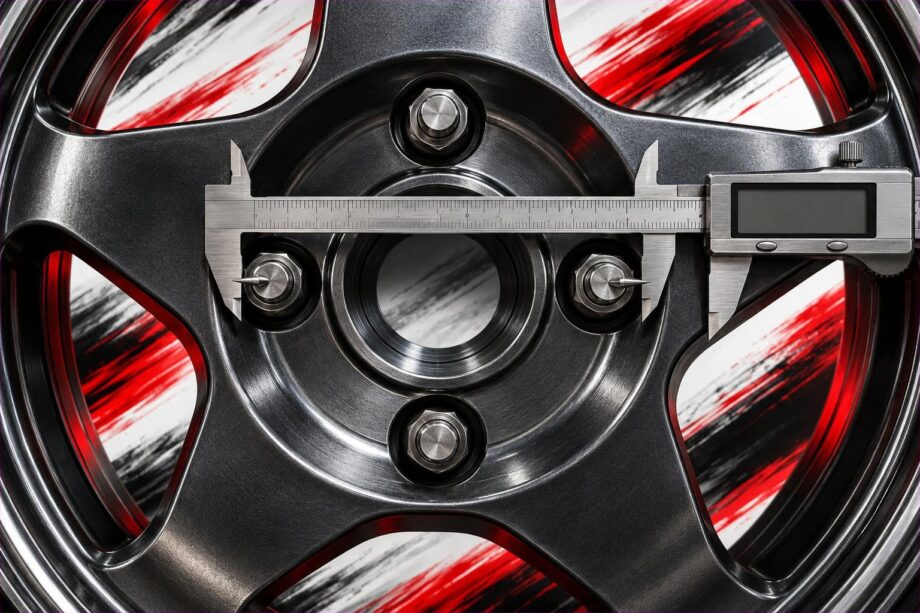
Measure centre-to-centre between two studs directly opposite each other. That distance is the PCD. No geometry, no calculator. 100 and 114.3 are 14 mm apart — you cannot confuse them once you have a rule on the hub.
While you are there, measure the hub register too. Our hub bore reference covers it, and on the cars above marked “not researched”, your measurement is better data than anything published.
If You Are Selling
State the PCD, the hole count and the bore for the wheels themselves, not the car they came off. If you only know the car, state the grade and build date, not just the model — because on seven of the cars above, the model name does not determine the answer.
We would rather see a slower, correct listing than a fast one that ends in a return.
Related Guides
- Same Chassis Code, Two Bolt Patterns
- Which JDM Cars Changed Bolt Pattern, and When
- Hub Bore: The Number Nobody Publishes
- Staggered From the Factory
Additions, August 2026
Three more Honda entries verified on cars-japan.net. All are 4 × 114.3 with no published hub bore, which is itself worth recording — 103 rows across the Ascot family and 31 across the Vigor, every one with the bore column left as a dash.
| Car | Chassis codes | Hub bore | Rows |
|---|---|---|---|
| Honda Ascot | CB1, CB2, CB3, CB4, CE4 | not listed | 73 |
| Honda Ascot Innova | CB3, CB4, CC4, CC5 | not listed | 12 |
| Honda Rafaga | CE4, CE5 | not listed | 18 |
| Honda Vigor | CB5, CC2, CC3 | not listed | 31 |
| Honda Accord Inspire | CB5 | not listed | 12 |
| Honda Inspire and Saber (to 1998) | CC2, CC3, UA1, UA2, UA3 | 64 mm | 25 |
Note the inconsistency in the last two rows against the fourth: the Inspire table publishes 64 mm for CC2 and CC3, while the Vigor table — covering those same chassis codes — leaves the bore blank. We have not carried the 64 mm figure across into the Vigor rows, because a bore is exactly the number where being nearly right is worse than admitting you do not know.
Additions, batch of August 2026
Two more four-lug 114.3 entries, both unusual:
| Car | Chassis code | Hub bore | Rows | Size |
|---|---|---|---|---|
| Mitsubishi Colt Ralliart Version R | Z27AG | 67 mm | 16 | 6.5J × 16 +43 |
| Nissan Tiida 1.8 6MT (as recorded) | JC11 | 66 mm | 3 | 5.5J × 15 +40 |
The Colt entry is the more useful of the two and the more surprising: every other Colt, Colt Plus and naturally-aspirated Colt Ralliart row is 4 × 100 on a 56 mm bore. Only the turbocharged Version R, chassis code Z27AG, is 4 × 114.3 — and at 67 mm rather than Mitsubishi’s usual 56. We read all sixteen rows and they agree, but the bore figure is unusual enough that we would measure before buying.
The Tiida rows are included for completeness and with a warning: they contradict every other Tiida row in the database, and we could not corroborate them anywhere else. Treat them as unconfirmed.
Additions, second batch of August 2026
| Car | Chassis code | Hub bore | Rows | Note |
|---|---|---|---|---|
| Mitsubishi Eterna | E32A through E84A | not listed | 154 | The single largest four-lug 114.3 entry we have found |
| Mitsubishi Legnum, ordinary grades | EA1W–EA7W, EC1W–EC7W, non-VR-4 EC5W | 56 mm | 69 | The VR-4 EC5W is five-stud at 67 mm |
| Mitsubishi Dion | CR5W, CR6W, CR9W | not listed | 74 | A seven-seat MPV on four studs |
| Honda Torneo, ordinary grades | CF3, CF4, CF5, CL3 | 64 mm | 54 | The CL1 Euro R is five-stud |
Two of these — the Legnum and the Torneo — are cars where the performance grade moves to five studs while the ordinary grades stay on four. That is now a recognisable pattern rather than a coincidence, and it means the chassis code matters more than the model name on both.
Additions, third batch of August 2026
| Car | Chassis codes | Hub bore | Rows |
|---|---|---|---|
| Mitsubishi Eterna | E32A–E84A | not listed | 154 |
| Mitsubishi Eterna Sava | E32A–E39A | not listed | 47 |
| Mitsubishi Emeraude | E52A, E53A, E54A, E64A, E84A | not listed | 40 |
| Nissan Largo | W30, NW30, VW30, VNW30 | not listed | 168 |
| Nissan Vanette Serena | C23 series | not listed | 144 |
The two Nissans are the notable ones: full-size seven-seat MPVs on four studs. Load rating, not just bolt pattern, is the constraint when shopping for these. Note also that the Vanette Serena’s successor, the C24 Serena of 1999, is five-stud — same nameplate, different fitment.
With these five entries the four-lug 114.3 list now runs to well over a thousand database rows, spread across Honda, Mitsubishi and Nissan. It is a small market in production terms but not a small list of cars.