Read this alongside our 370Z guide and something strange emerges: Nissan reversed its own thinking between the Z33 and the Z34.
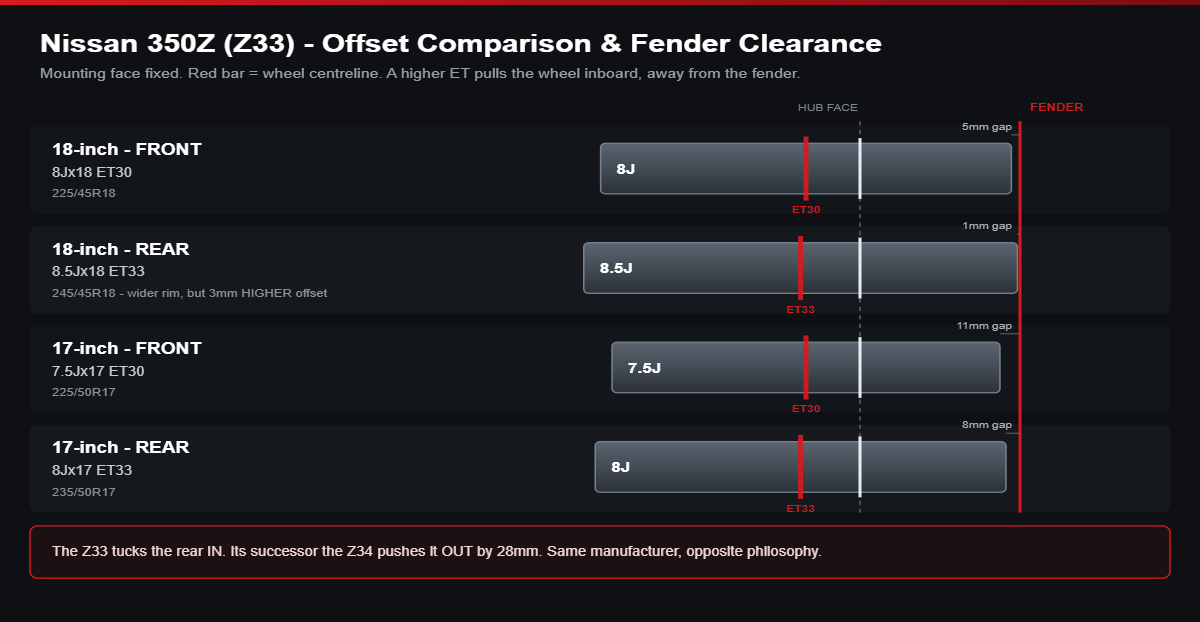
The 370Z pushes its rear wheel outboard by 28 mm relative to the front. The 350Z does the opposite — the rear rim is half an inch wider, but it sits at ET33 against the front’s ET30, three millimetres further in. Two consecutive generations of the same car, two opposite answers to the same question.
Section 1: OEM Wheel Specifications
| Package | Bolt Pattern | Hub Bore | Thread | Front Wheel | Rear Wheel | Tyres (F / R) |
|---|---|---|---|---|---|---|
| 17-inch | 5×114.3 | 66.1 mm | M12x1.25 | 7.5Jx17 ET30 | 8Jx17 ET33 | 225/50R17 / 235/50R17 |
| 18-inch | 5×114.3 | 66.1 mm | M12x1.25 | 8Jx18 ET30 | 8.5Jx18 ET33 | 225/45R18 / 245/45R18 |
Bolt pattern, hub bore and thread are identical across both packages. Wheel nut torque is in the region of 98–127 Nm depending on year and market.
Section 2: Offset Comparison & Fender Clearance Visualization
Section 3: Why This Makes the 350Z Easy
The narrow 3 mm split has a very practical upside: the Z33 is one of the most forgiving Japanese sports cars to fit aftermarket wheels to.
- A square set works. Four identical ET30 wheels look and behave correctly, unlike on a 370Z where a square set is visibly wrong at one end.
- Rotation is possible on the 17-inch car with matched tyre sizes, which the Z34 does not allow.
- The aftermarket’s normal offset range lands where you want it. Most 18×9 and 19×9.5 wheels are made in ET20–ET35, which is exactly the Z33’s territory.
This is the opposite of the problem the NSX presents at ET55–ET60, and the opposite of the 370Z’s ET15 rear.
A Fairlady Z Z33 in its home market — the generation with the near-square factory offset. — via @@autoculturej
Section 4: Popular Aftermarket Sizes
- 18×9.5 ET22 front / 18×10.5 ET22 rear — the classic square-offset staggered-width setup. Fills the arches without body work on a car at stock height.
- 19×9.5 ET22 / 19×10.5 ET22 — the same idea an inch larger. Watch tyre choice to keep the rolling diameter close to factory.
- 18×9 ET30 / 18×10 ET30 — conservative, factory-equivalent. No rubbing at any sensible ride height.
- 18×10 ET15 rear — aggressive street fitment. Fender roll and camber expected.
The Z33’s practical limit on standard arches is around ET15 at 10 inches wide at the rear. Below that you are rolling or replacing bodywork.
Section 5: Brake Clearance
Track and NISMO 350Zs carry Brembo four-piston front calipers, and those cars need 18 inches as a working minimum. Base cars on the 17-inch package have smaller brakes and can run 17s freely.
If you are buying a 17-inch set for a 350Z, confirm which brake package the car has. It is a more common upgrade than most listings mention.
Section 6: The 66.1 mm Nissan Bore
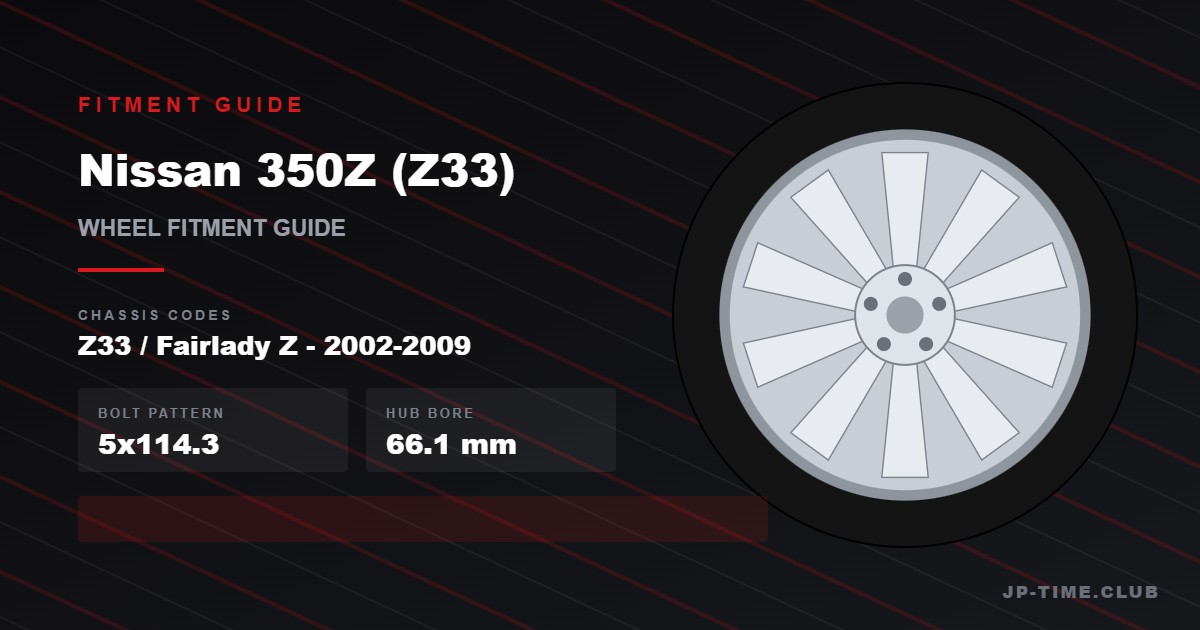
Standard Nissan fitment — 5×114.3 / 66.1 mm / M12x1.25 — shared with the 370Z, Z32 300ZX, S14, S15, R32 GT-R, R33 and R34.
- 370Z wheels fit, but check which axle they came from. See our 370Z guide.
- Skyline GT-R wheels fit — an R33 or R34 9J ET30 is close to ideal on a Z33 front. See our R33 guide.
- Silvia S14 / S15 wheels fit but sit conservatively at ET40–45.
- Toyota wheels (60.1 mm) will not fit at all. Evo and RX-7 FD wheels (67.1 mm) need hub rings.
Related Fitment Guides
- Nissan 370Z — the successor, and the reversal
- Nissan Z (RZ34) — the current Z
- Nissan Silvia S15 — a direct wheel swap
- Nissan 300ZX Z32 — the Z that came before
Every guide in this series is built the same way: verified factory specifications, an offset diagram, and an honest account of what fits and what does not.
Seen on the road
Which wheels are you looking for? Tell us the wheel, the size and the fitment — send us a request and we will go and find it.
Wheel identification is taken from the hashtags the owner applied to their own post.
Buying Wheels for Your 350Z
The Z33 asks less of you than most cars in this series. Diameter, width, offset, bore — and which brake package you have. Get those and almost anything in the mainstream Japanese catalogue will work.
Looking for a specific set? We specialise in genuine Japanese wheels — RAYS, Volk, Enkei, SSR, WORK, BBS Japan and the rare discontinued sets that never left the country. Tell us the wheel, the fitment, the year — our team searches our networks until we find it.
Specifications in this guide reflect factory equipment for Japanese-market vehicles. Trim levels, optional wheel packages and market-specific variants can differ. Always confirm the fitment against your own car before purchase.