
The Short Version
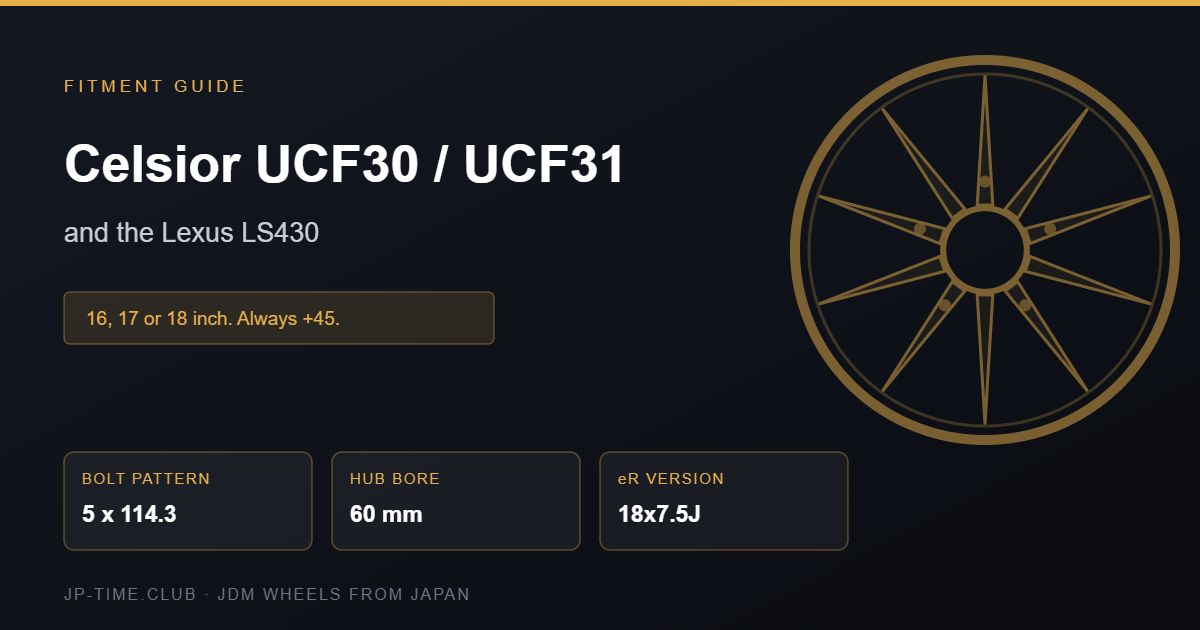
- 5×114.3 with a 60 mm hub bore on the UCF30 and UCF31 — the same as the earlier UCF20 Celsior.
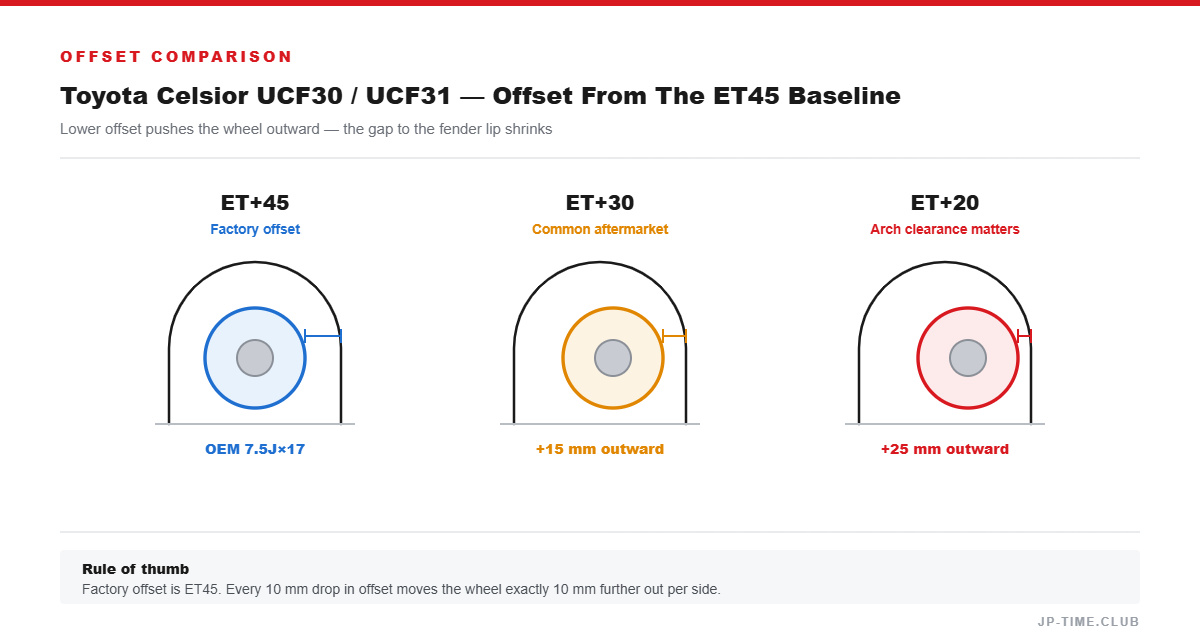
- Offset is +45 across the range. Only the diameter changes.
- 16 inch on the early cars, 17 on the 2004 facelift, 18 on the eR version. All at +45.
- We found no separate air-suspension wheel specification. If you have seen one quoted, treat it with caution.
Factory Specification
| Chassis | Period | Grade | Wheel | Tyre | PCD / Holes / Bore |
|---|---|---|---|---|---|
| UA-UCF30 | 2000.08–2003.08 | 4.3 A version 5AT | 16×7J +45 | — | 114.3 / 5 / not opened |
| CBA-UCF30 | 2004.02–2006.05 | A version | 17×7.5J +45 | 225/55R17 | 114.3 / 5 / 60 |
| CBA-UCF30 | 2004.02–2006.05 | eR version | 18×7.5J +45 | 245/45R18 | 114.3 / 5 / 60 |
| DBA-UCF31 | 2004.07–2006.05 | C version, long wheelbase | 17×7.5J +45 | 225/55R17 | 114.3 / 5 / 60 |
| UA / CBA-UCF31 | 2001.08–2004.07 | C version F Package, Interior Selection | 16 or 17 inch by year, +45 | — | 114.3 / 5 / not opened |
Reading the Grade Names
Celsior grade naming is opaque if you have not seen it before, and it decides what wheel the car has.
- A version — the base car.
- B version — the middle grade, dropped at the August 2003 facelift.
- C version — the long-wheelbase car, and it carries a different chassis code: UCF31 rather than UCF30. This is the direct equivalent of the Lexus LS430 L.
- eR version — the sport-tuned trim, and the only one on 18 inch.
So if you are shopping for factory 18s, you want an eR version. Everything else is 16 or 17 inch depending on the year.
Consistency With Our Other Guides
The UCF30 and UCF31 figures of 5×114.3 on 60 mm match what we publish for the earlier UCF20 Celsior and LS400, and what our LS430 guide states.
They also match the Crown family — the Crown Athlete, the Majesta, the Progres and Brevis — all of which are 5×114.3 on 60 mm.
So the whole Toyota luxury range of this era is one bolt-on family. What separates them is offset: the Celsior at +45, the Crown Athlete at +50, the Progres at +58, and the S200 Majesta at +39. All interchange; none sit in the same place.
On the Air Suspension
Our own notes suggested the air-suspension cars might carry a distinct wheel specification. We found no evidence of that. The factory wheel tables do not flag air-suspension cars separately, and the grades that have it do not show different wheel figures.
Air suspension on the Celsior was fitted according to grade rather than sold as a wheel-affecting option, so there is no reason to expect a separate fitment. If you have seen an air-suspension-specific wheel spec quoted, we could not reproduce it.
Sizing
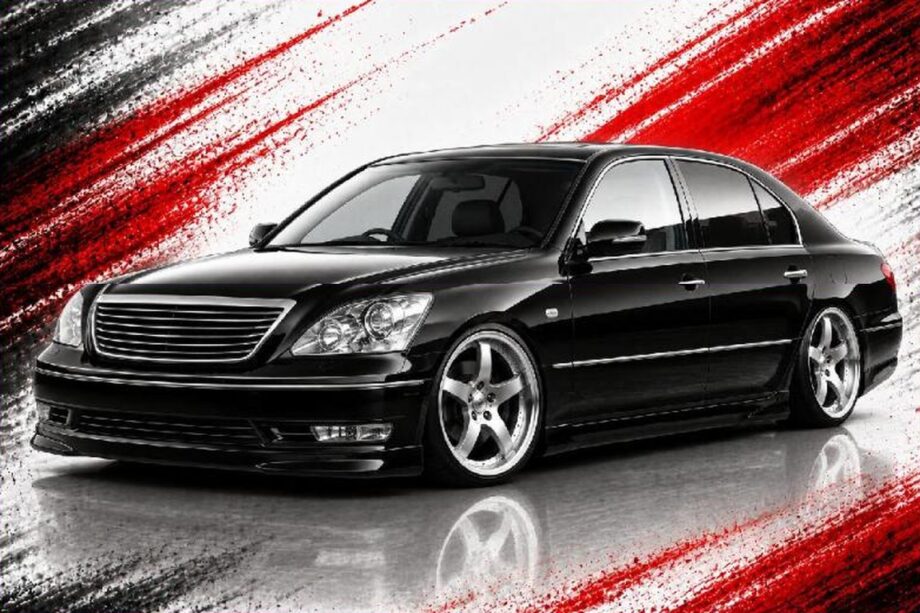
+45 on a 7.5J is moderate, and the Celsior is a wide car with room. The usual VIP-style move is 19×9J to 20×9.5J in the +20 to +40 range, often with camber.
Watch load rating rather than weight. This is a two-tonne car and most Japanese wheel makers do not publish a load figure.
Importing
The UCF30 launched in August 2000. Cars built through August 2001 are eligible for US import now — roughly the first year — with the rest following month by month to 2031.
North America had this car as the Lexus LS430 throughout, so a JDM Celsior is a right-hand-drive and grade choice. The eR version is the grade with no direct US equivalent.
What We Could Not Verify
- Hub bore on the pre-2004 UA-chassis A, B and C version grades. We opened the 2004-onward pages; the earlier grades were read from the index, which gives wheel size only.
- Export-market Lexus LS430 figures, which are not in the Japanese databases. If our LS430 guide states anything other than 5×114.3 on 60 mm, it is worth a check against a US source.